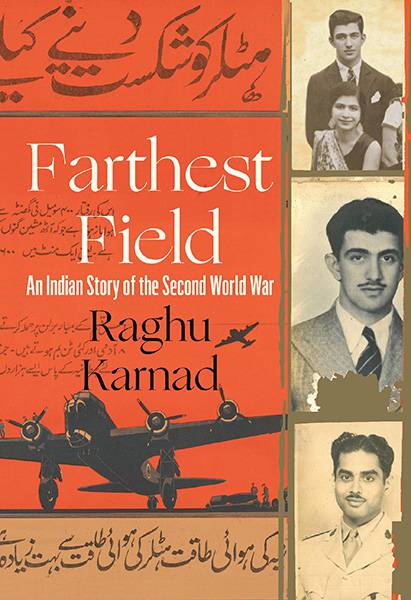
The photographs of three young men had stood in his grandmother’s house for as long as he could remember, ‘beheld but not noticed, as angels are in a frieze of mortal strugglers’. They had all fought in the Second World War, a fact that surprised him. Indians had never figured in his idea of the war, nor the war in his idea of India. One of them, Bobby, even looked a bit like him, but Raghu Karnad had not noticed until he was the same age as they were in their photo-frames. Then he learned about the Parsi boy from the sleepy south Indian coast, so eager to follow his brothers-in-law into the colonial forces and onto the front line. Manek, dashing and confident, was a pilot with India’s fledgling air force; gentle Ganny became an army doctor in the arid North-West Frontier. Bobby’s pursuit would carry him as far as the deserts of Iraq and the green hell of the Burma battlefront.
The years 1939-45 might be the most revered, deplored and replayed in modern history. Yet India’s extraordinary role has been concealed, from itself and from the world. In riveting prose, Karnad retrieves the story of a single family – a story of love, rebellion, loyalty and uncertainty – and with it, the greater revelation that is India’s Second World War. Farthest Field narrates the lost epic of India’s war, in which the largest volunteer army in history fought for the British Empire, even as its countrymen fought to be free of it. It carries us from Madras to Peshawar, Egypt to Burma – unfolding the saga of a young family amazed by their swiftly changing world, and swept up in its violence.
Reviews
‘I have not lately read a finer book than this – on any subject at all… A book that will long survive, I suspect, as a masterpiece.’ – Simon Winchester in the New Statesman
‘From the very first page it is the brilliance of the writing that stands out… The imaginative power, intelligence and descriptive richness of a narrative that, again and again, startles by its originality before convincing by its utter fitness.’ – David Crane in the Spectator
‘A spectacular first book… He writes with the imaginative gift of a first-rate novelist in order to deliver the truth.’ – Juliet Nicolson in the Telegraph (UK)
‘A bravura feat of literary-historical imagination… The writing of history intersects gloriously with several other genres in this moving, eloquent, intelligent work.’ – Neel Mukherjee in the Financial Times (UK)
‘With consummate skill he creates startling graphic images that fix in our minds all that he sees, interprets and discovers… It is not only a thinking book. It is also a profoundly feeling book.’ – Shanta Gokhale in the Mumbai Mirror
‘One of India’s most brilliant and talented young writers.’ – William Dalrymple in the New Statesman
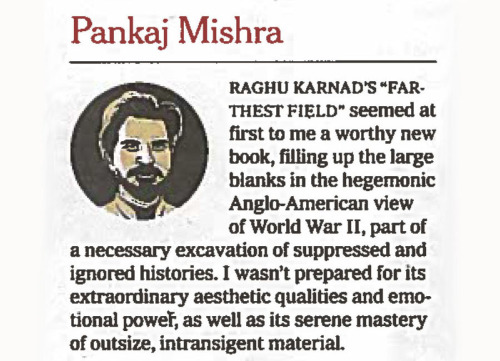
Pankaj Mishra’s ‘Best Book of 2015′ in the New York Times
‘A contemplation on heroism and circumspection, ambition and content, purpose and futility, dogma and desire.’ – Nandini Krishnan on Sify
‘Both a poignant memorial to his lost family and a gripping account of how India contributed to the Allied victory and sowed the seeds of its independence.’ – Ian Critchley in the Sunday Times (UK)
‘Farthest Field tells a grim and epic tale, but it is also full of charm and playfulness… An audacious achievement for a first book.’ – Ferdinand Mount in the Telegraph (Calcutta)
‘That this is Karnad’s first book just goes to show that well-crafted writing needs no authorial pedigree’ – John Keay in the Literary Review
‘Few books, apart from the novels of Rohington Mistry, better communicate to outsiders the dilemmas of modern Parsi life; few conventional histories so effectively convey the personal trauma of war.’ – David Arnold in the Times Literary Supplement
“One of those rare and extraordinary books which bring people alive again… Written with imagination and engrossing to read.” – Sir Michael Holroyd
‘Karnad’s prose, heartfelt and hauntingly poetic, evokes an India at the crossroads.’ – ☆ review in Publishers’ Weekly
‘A gorgeously written, heart-breaking book’ – Vedica Kant in Business Standard
‘Karnad’s research is top-class and he gets the nuances right… He brings alive a war that shaped an army independent India called its own.’ – Sushant Singh in the Indian Express
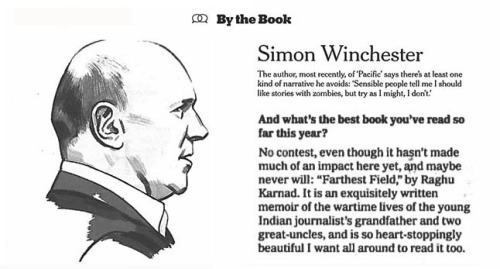
Simon Winchester’s ‘Best Book of 2015′ in the New York Times
‘It’s one of the most perspective-changing books I’ve ever read.’ – Molly Crabapple in the Pacific Standard
‘Karnad is battling the passage of time, and the passing of generations, but his work is a stunning work of recovery and commemoration.’ – Matthew Price in the National (Abu Dhabi)
‘It aims not for documentary-like veracity but to reveal deeper, poetic truths about people, their private and public battles, and about the histories that are in danger of slipping away from us.’ – Jai Arjun Singh on Scroll.in
‘Equal parts genealogy, political history, and literary storytelling.’ – Neha Sharma in the LA Review of Books
‘Karnad’s skilful achievement is to take us on an epic journey, while subtly revising our perspective on the Second World War… The ‘Afterword’ is worth the price of the book itself.’ – Andrew Duff in the Military History Monthly
‘It tells an exciting story and it tells it well, of a number of interesting (and attractive) young people, who found themselves participating in arguably the biggest adventure in the world’s history.’ – KS Nair on Bharat Rakshak
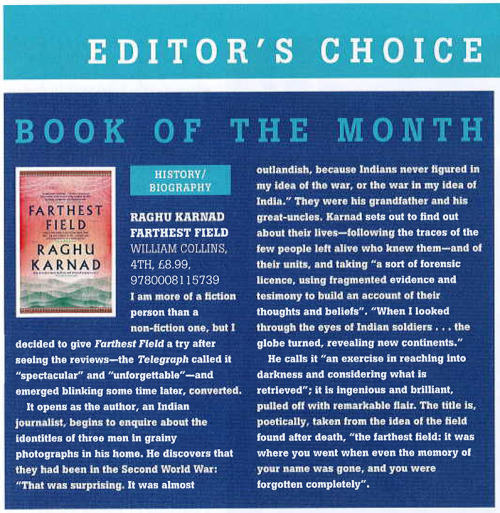
The Bookseller’s Paperback Preview ‘Book of the Month’ for April 2016
About the essay Everybody’s Friend: “Nothing short of brilliant… engaging with matters of real seriousness with delicately thoughtful elegance” – Simon Schama in the Financial Times